weber.tec Superflex 2K
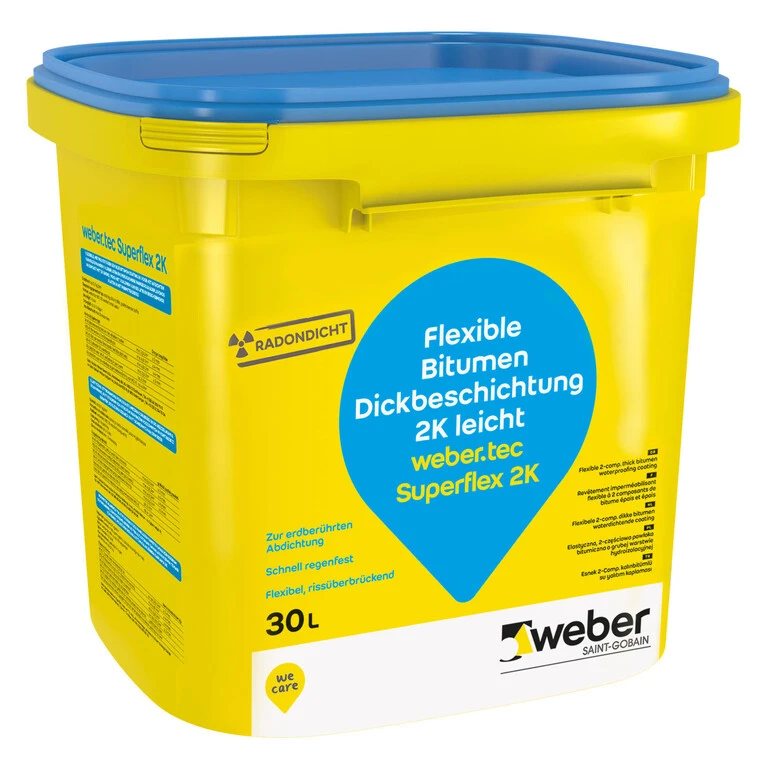
weber.tec Superflex 2K
Polystyrene-filled, flexible and radon-tight 2-comp. bitumen waterproofing compound for earth-contacting building parts

Application thickness:
depends on the category of water load; see figures herebelow under “Consumption”
Drying time:
approx. 2 - 3 days
Storage:
The product can be stored for at least 12 months in its original unopened packaging if kept dry, cool and frost-free. Frost destroys the bitumen component. After thawing, it is not allowed to be used.
Fields of application
weber.tec Superflex 2K is used for waterproofing earth-contacting basement walls (masonry and concrete), concrete floor slabs, lean concrete (i.e. beneath floor concrete slab), foundations in the cases of ground damp, nonpressure and pressure water.
Convenient for waterproofing earth-contacting concrete ceilings of car parking (underground) in case of non-pressure water.
Also for protection of socket areas of the facade against splash water (Underneath ETIC systems).
Also for the intermediate waterproofing of wet-duty rooms, not-inhabited balconies and terraces under floor screed.
In addition, for spot-bonding or full-surface bonding of extruded polystyrene rigid-foam boards used as protective, drainage or perimeter insulation boards (depending on the specific use) on the presaid building parts.
For use outdoors and also indoors (under screeds).
Main features
- CE marking: classes W2A – CB2 – C2A
- solvent-free
- flexible and crack-bridging
- long pot life
- quickly resistant to rain after 3 - 4 hours
- suitable for any mineral substrates; no cement render is necessary on masonry
- resistant to ageing
- resistant to water attacking concrete up to the level "highly corrosive" in accordance with DIN 4030 (up to 3.000 mg sulphate per liter of water) and also to seawater
- resistant to frost and thawing salts after full drying
- radon gas-tight (with official test report)
- sprayable with peristaltic pump and screw pump technology, e.g. Wagner PC 1030 with air support
General notes
- All characteristics mentioned in this data sheet are given for a temperature of +20 °C, without a draft and a relative rate of humidity of 70%.
- In the case of pressure water, steel-reinforced concrete must satisfy the national standards (for ex. EN 206); if not issued and if necessary, request technical advice.
- In case of sunshine, carry out waterproofing works in shadow or in the morning or evening hours.
- Do not bond protective boards or insulation boards, and do not fill the excavation pit until the material has completely dried.
- Prior to backfilling of the excavation pit, lay the fleece-lined drainage and protection foil weber.sys 983 over the basement walls in order to protect the waterproofing system.
- Comply with the national standards and/or guidelines; if not issued, and if requested, refer to the norm DIN 18533 (“Waterproofing of Ground-contacting Building Structures”), the “Guideline for Planning and Execution of Waterproofing Works with Polymer-Modified Bitumen Coatings (PMBC)” (4th edition, Dec. 2018, issued by the German Construction Chemicals Association) and the WTA leaflet “Retrospective Waterproofing of Ground-contacting Structures” (WTA = International Association for Science and Technology of Building Maintenance and Monuments Preservation) and/or request technical advice.
- Follow the guideline relating to waterproofing works of water-impermeable concrete structures (working joints and butt joints between pre-cast concrete wall elements and connection area between the water-impermeable concrete floor slab and wall elements); if not issued, request technical advice.
Special notes
- Do not mix with other substances during mixing and application.
- Observe the Weber application tip “General guidelines for basement waterproofing works with thick-layer bitumen coatings and reactive coatings” for full information related to important issues, like an assessment of water load, thickness control and all execution details.
- The consumption figures given in this document will increase if the applicator lacks experience. In addition, the figure of 1.0 - 1.5 liter/m² for the scratch layer depending on the substrate roughness must be taken into account.