Sustainability – A Glossary
The discussion around sustainability is causing a stir in the construction industry. However, the terminology used is not always clearly defined. For example, is Cradle to Cradle just another term for the circular economy? What is the difference between sustainable and ecological building? And which is better—DGNB certification or LEED certification?
Our Sustainability Glossary defines the most common terms related to sustainable construction.
| BAFA | stands for the Federal Office for Economic Affairs and Export Control, which is responsible for processing grant and subsidy applications |
| BEG | BEG stands for Federal Funding for Efficient Buildings – a funding program managed by the Federal Office for Economic Affairs and Export Control (BAFA). It is divided into three categories: funding for residential buildings (BEG WG), Funding for non-residential buildings (BEG NWG) and funding for individual measures (BEG EM) |
| BREEAM | stands for Building Research Establishment Environmental Assessment Method – a certification system that focuses on environmental aspects, while also taking social and health-related factors into account |
| Blue Angel | is the German government's environmental label. It identifies environmentally friendly non-food products and services |
| BNB | stands for Assessment System for Sustainable Building – a certification system for public sector buildings in Germany |
| Cradle to Cradle | means "from origin to origin". It is a design approach in which products or their raw materials are either returned to the biological cycle or kept within the technical cycle. This concept contrasts with the principle of the linear economy |
| Cradle to Gate | refers to the assessment of a product's environmental impact from the extraction of raw materials to the point at which the product leaves the factory |
| Cradle to Grave | refers to the assessment of a product's environmental impact throughout all phases of its life cycle, including manufacturing, transportation, use and disposal |
| DGNB | stands for the German Sustainable Building Council – a certification system that focuses on ecological, economic, process-related, sociocultural, functional, technological and location-based aspects |
| EEG | stands for the Renewable Energy Sources Act, which governs the expansion of renewable energy in Germany |
| EMICODE | is a quality label for low-emission construction products, awarded by the GEV (Association for the Control of Emissions in Products for Flooring Installation) |
| EnEV | steht für Energieeinsparverordnung; 2020 außer Kraft gesetzt; die EnEV wurde vom Gebäudeenergiegesetz (GEG) abgelöst |
| End of Life | steht für Ende der Nutzungsphase eines Produkts |
| EPD | stands for Environmental Product Declaration – a document that provides information about the environmental impacts of a building material. [More information is available here] |
| GEG | stands for the Building Energy Act, which is the legal framework covering all aspects related to the energy consumption of buildings for property owners |
| GEV | stands for the Association for the Control of Emissions in Products for Flooring Installation, Adhesives, and Construction Products (registered association under German law) – a market-monitoring institution that awards the EMICODE quality label |
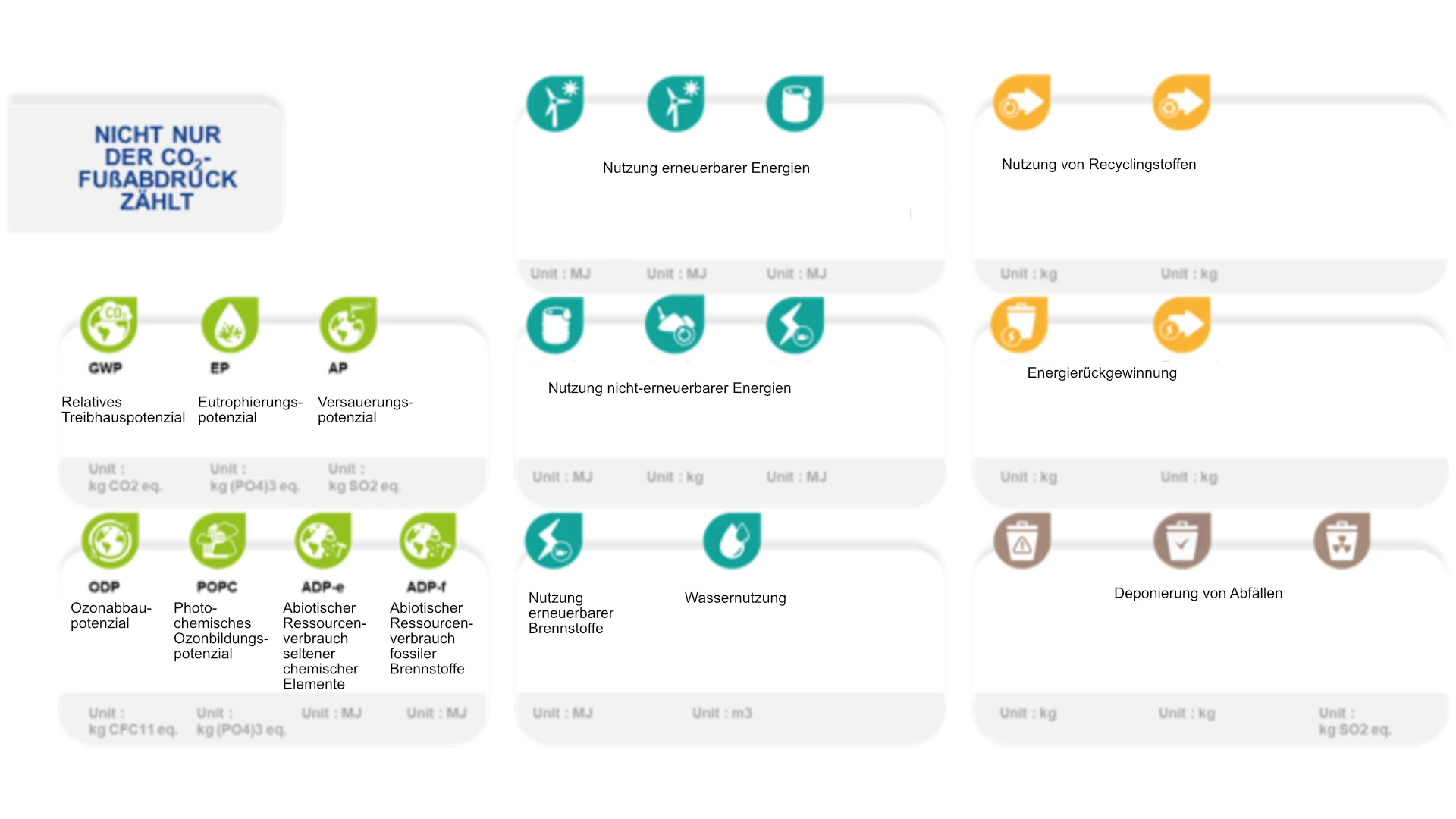
| GWP | stands for Global Warming Potential – a measure of the climate impact or greenhouse effect of substances |
| IBU | stands for the Institute for Construction and Environment (registered association under German law) – responsible for verifying Environmental Product Declarations (EPDs) |
| KfW | stands for the Kreditanstalt für Wiederaufbau (Reconstruction Loan Corporation) – the office responsible for processing applications for subsidised loans |
| Circular Economy | is often described using the term "Cradle to Cradle", which emphasises the continuous use and reuse of resources |
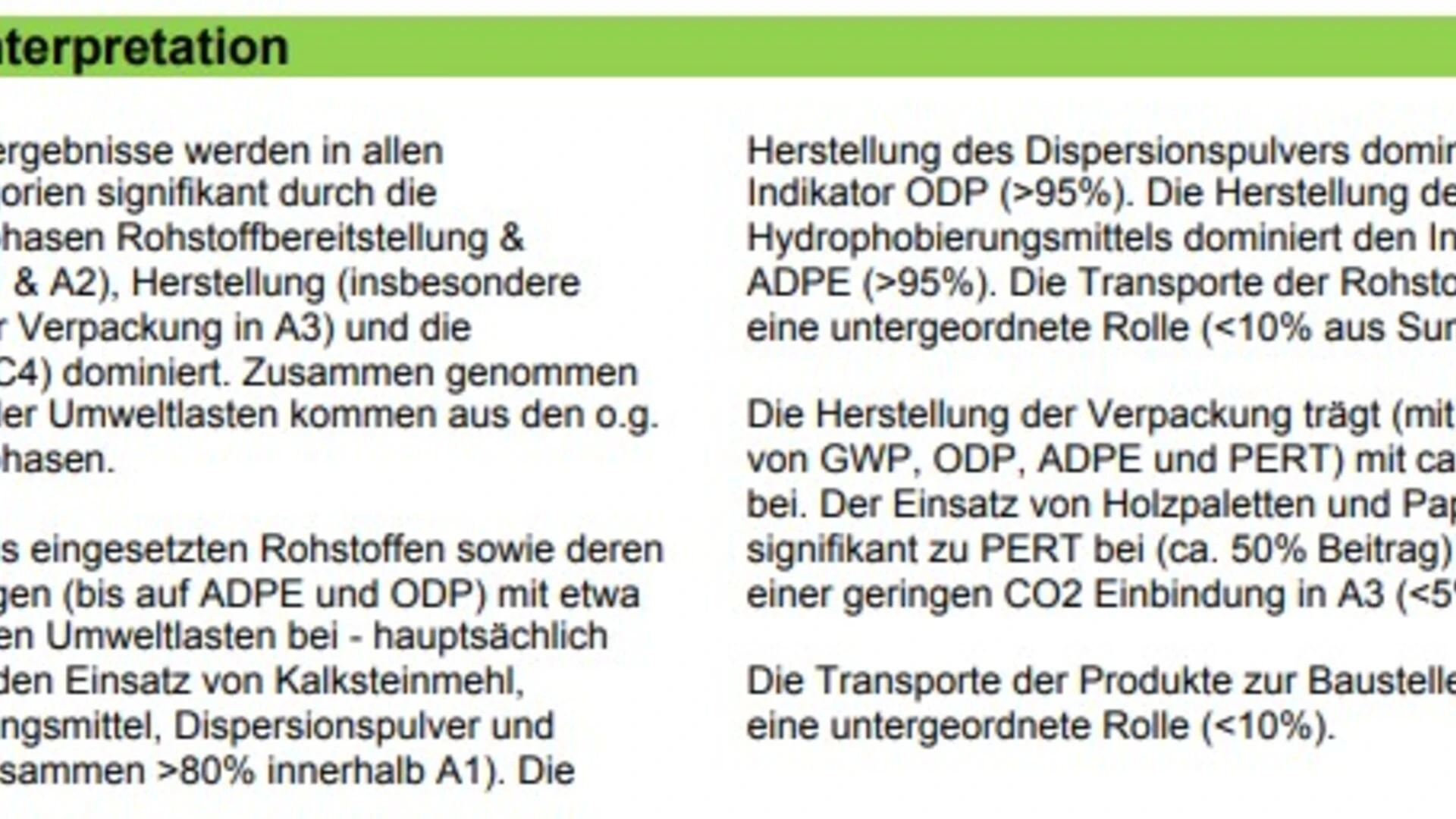
| LCA | stands for life cycle analysis, also known as a life cycle assessment or environmental balance. It covers the environmental impact of a building material throughout its entire life cycle, from production to usage and disposal. The analysis is divided into four phases: Goal definition, Life Cycle Inventory (LCI) Analysis (data collection and quantification), Life Cycle Impact Assessment (LCIA) (impact evaluation), and Interpretation |
| LCI | stands for Life Cycle Inventory Analysis - the second stage of a life cycle assessment. It involves compiling all relevant input and output data prior to the impact assessment |
| LCIA | stands for Life Cycle Impact Assessment - the third stage, where the environmental impacts of the collected data are evaluated |
| LEED | stands for Leadership in Energy and Environmental Design – a certification system that focuses on the environmental performance of buildings |
| Sustainability | encompasses not only ecological aspects, but also the economic and social dimensions of a building project in the construction industry |
| PCR | stands for Product Category Rule, which is a set of rules that defines how life cycle assessments should be conducted for specific product groups |
| QNG | stands for Quality Seal for Sustainable Buildings – a government-issued certification for buildings, awarded by accredited certification bodies |
| RAL | stands for Reichs-Ausschuss für Lieferbedingungen – now known as the German Institute for Quality Assurance and Certification |
| REACH | is the EU regulation governing chemical safety and stands for Registration, Evaluation, Authorisation and Restriction of Chemicals |
| WGBC | stands for World Green Building Council – an international organisation that oversees quality standards in global building assessment systems |
| WEG | stands for the German Residential Property Act, which is the legal framework for residential property ownership |